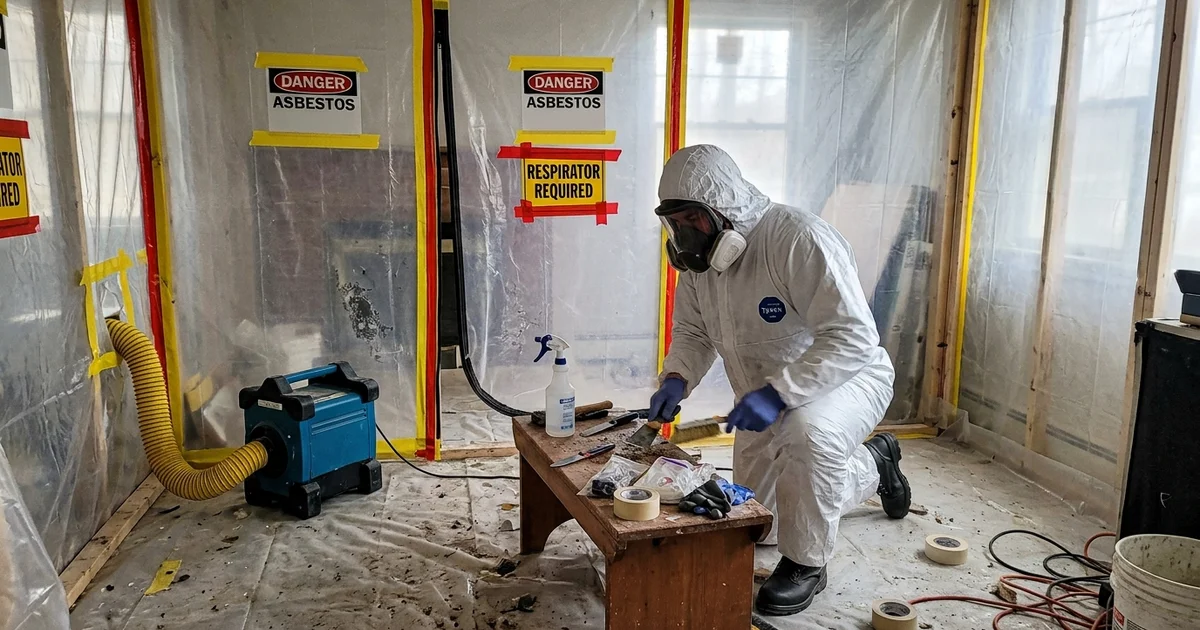
<p>We observe daily how an accurate asbestos assessment changes the trajectory of a complex estate cleanout. Managing an inherited property or a severe hoarding situation brings enough stress without unexpected legal liabilities. The precise classification of asbestos hazards determines the required safety controls and your final costs.</p>
<p>Our team provides asbestos abatement and specialty cleaning assessments that comply with o reg 278/05 asbestos standards. This provincial law sorts all abatement work into three distinct operation types based on the risk of fibre release.</p>
<p>Let’s break down how this classification system works and outline what each operation type actually requires.</p>
Why Classification Decides Everything
<p>We know that misclassifying asbestos work can derail an entire estate liquidation timeline.</p>
<p>Ontario defines asbestos containing material, or ACM, as any material containing 0.5 percent or more asbestos by dry weight. Fines for violating these rules under the Occupational Health and Safety Act can reach up to $1,500,000 for corporations and $100,000 for individuals.</p>
<p>Our project managers treat this regulatory framework as the ultimate blueprint for protecting your family and contractors. Statistics Canada data shows that in communities like Hamilton, over 32 percent of the housing stock was built before 1960. That age bracket makes the presence of hazardous materials highly likely in these older family homes.</p>
| Classification Risk Level | Impact on Estate Cleanout |
|---|---|
| Under-classified (Too Low) | Risks massive Ministry of Labour fines, stop-work orders, and dangerous health exposures. |
| Over-classified (Too High) | Unnecessarily inflates budget constraints for families already dealing with probate costs. |
| Accurately Classified | Ensures legal compliance, predictable timelines, and safe transitions for inherited properties. |
The Three Operation Types
Type 1: Lowest Risk Operations
<p>We approach Type 1 operations as basic, controlled removals of non-friable materials. Non-friable materials hold their fibres tightly bound in a matrix until they are aggressively cut or sanded.</p>
<p>Intact vinyl floor tiles commonly found beneath hoarded debris fall into this category.</p>
<p>Our crews use basic precautions like wetting the material, controlled hand removal, and appropriate respiratory protection. Friability is the core concept separating this tier from more dangerous categories. Friable material crumbles to powder under simple hand pressure when dry.</p>
Type 2: Moderate Risk Operations
<p>We classify work as Type 2 when moderate disturbances of hazardous materials are unavoidable.</p>
<p>This classification covers specific, limited actions:</p>
- Removing minor sections of a suspended ceiling to access utilities.
- Cleaning up small, isolated pockets of friable debris.
- Encapsulating intact asbestos materials with specialized sealants.
<p>Our specialists set up localized containment barriers to ensure fibres do not migrate into clean areas of the home.</p>
<p>Unlicensed handymen often attempt to spray sealant over asbestos illegally. Ministry inspectors can issue immediate on-the-spot financial penalties for these unapproved encapsulation attempts.</p>
Type 3: Highest Risk Operations
<p>We handle type 3 asbestos abatement when required for large-scale removals of highly friable materials.</p>
<p>Sprayed-on fireproofing and extensive pipe insulation require this maximum level of intervention. A licensed Type 3 supervisor must remain physically present on site at all times during the procedure.</p>
<p>Our technicians must submit an official Notice of Project to the Ministry of Labour before beginning the work. The site requires a fully sealed enclosure operating under negative air pressure. Worker decontamination facilities must be built directly into the entry and exit points.</p>
Where Asbestos Is Found in Hamilton-Area Buildings
<p>We frequently discover asbestos hidden beneath decades of accumulated belongings during hoarder cleanouts.</p>
<p>Canada officially banned the import and use of asbestos on December 30, 2018. Construction applications were largely phased out by 1990.</p>
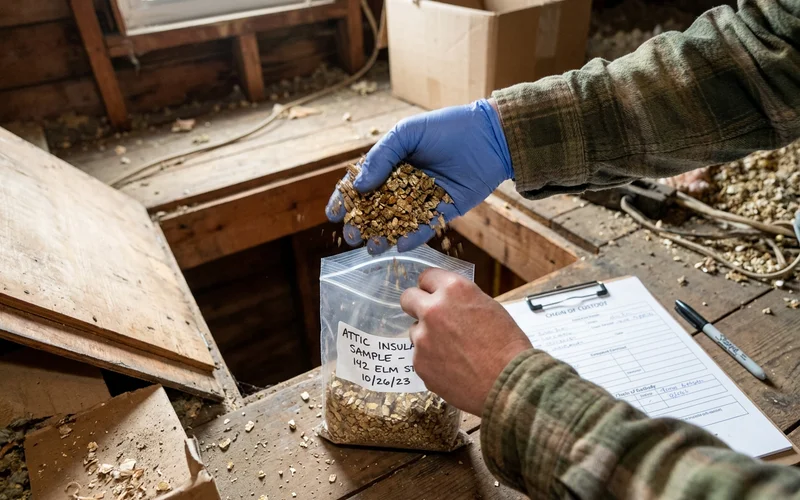
<p>Our assessment teams always target specific building components in homes constructed before those deadlines. Visual identification is completely unreliable for finding these hazards. Bulk sampling followed by accredited laboratory analysis is the only legally recognized method for confirmation.</p>
- Attic Spaces: Suspect vermiculite insulation often hides between joists.
- Basements: Pipe and boiler wrap insulation deteriorates over time.
- Living Areas: Textured ceiling finishes and drywall joint compound are prime suspects.
- Flooring: Old vinyl floor tiles and the black mastic adhesive beneath them frequently test positive.
- Exteriors: Cement board and original siding may contain bound fibres.
<p>We strongly advise testing before a major cleanout begins rather than after a wall is accidentally breached.</p>
<p>A pre-project survey gives executors a clear picture of potential liabilities. Taking proactive steps prevents a sudden project shutdown.</p>
What Type 3 Work Actually Involves
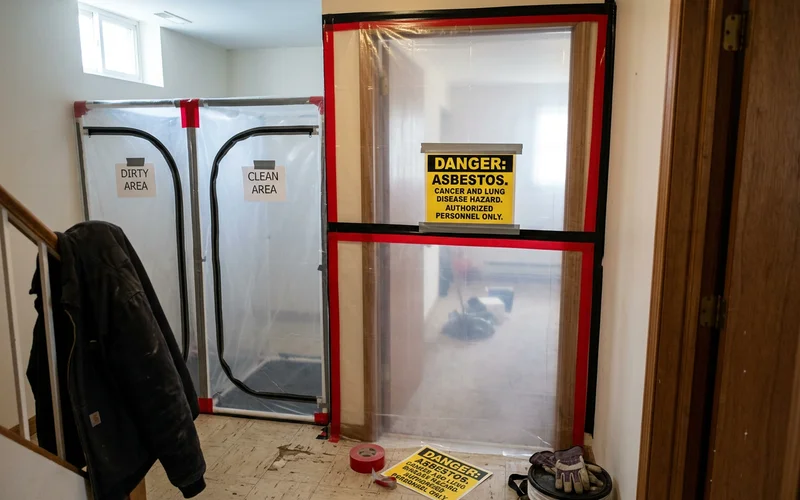
<p>We build a completely sealed containment zone around the work area for every Type 3 project.</p>
<p>Specialized negative air machines run continuously to prevent microscopic particles from escaping. These machines use High Efficiency Particulate Air filters rated to capture 99.97 percent of airborne contaminants.</p>
<p>Our technicians enter and exit through a mandatory three-stage decontamination facility. Workers wear full protective coveralls and powered air-purifying respirators at all times. Wet methods suppress dust release while the material is actively stripped away.</p>
The honest-classification point
Over-classifying a job inflates the cost by multiples, because a Type 3 enclosure is an entirely different project from a Type 1 operation. Under-classifying it is unlawful and unsafe. A firm that assesses the material and tells you it is a Type 1 operation is doing its job, not underselling.
<p>We place all hazardous waste into properly labeled, six-mil double poly bags.</p>
<p>Approved disposal facilities require very specific documentation for every single bag dropped off. Final clearance testing demands a visual inspection and aggressive air sampling before the containment barriers come down.</p>
Why DIY Is Not an Option
<p>We regularly warn families that handling asbestos without training invites catastrophic consequences.</p>
<p>The fibres are invisible, odourless, and cause severe disease decades after the initial exposure. A 2026 report on Canadian mesothelioma statistics confirms the latency period stretches between 20 and 60 years.</p>
<p>Our priority is making sure your family members do not suffer from asbestosis or lung cancer down the road. This delayed onset of symptoms removes the immediate feedback that usually keeps untrained people cautious. Improper disposal creates permanent legal liability that attaches directly to the property title.</p>
- Market Value Drops: Homes listed with managed or encapsulated asbestos can sell for 5 to 15 percent less in competitive markets.
- Disclosure Laws: Sellers must legally disclose known defects to potential buyers.
- Deferred Liability: Buyers often lower their purchase offers to offset future professional removal costs.
<p>We remind estate executors that their obligations under asbestos removal ontario law are absolute requirements rather than friendly suggestions.</p>
<p>Leaving hazardous materials unaddressed can stall a critical property sale indefinitely. Professional removal provides the clean slate needed to move forward.</p>
Common Trigger Situations
<p>We step in to help when an overwhelmed executor discovers suspect materials during a hoarding cleanout. Contractors also frequently halt mid-renovation upon opening a wall and finding old insulation.</p>
<p>A standard home inspection might flag a deteriorating pipe wrap just days before a real estate closing. Our teams follow the same strict sequence for every single scenario.</p>
<p>Stopping all disturbance immediately is the most critical first step. The official laboratory result will dictate the exact operation type required to proceed legally.</p>
Managing Secondary Discoveries
<p>We often find that large-scale cleanouts uncover secondary issues like extensive water damage.</p>
<p>Those hidden moisture pockets almost always require professional mould remediation alongside the hazardous material removal. Bundling these services into a single project saves the estate significant time and money.</p>
<p>Our experts will evaluate the site and classify the required work with complete honesty. Call for an assessment so you can finalize the estate clearance safely.</p>