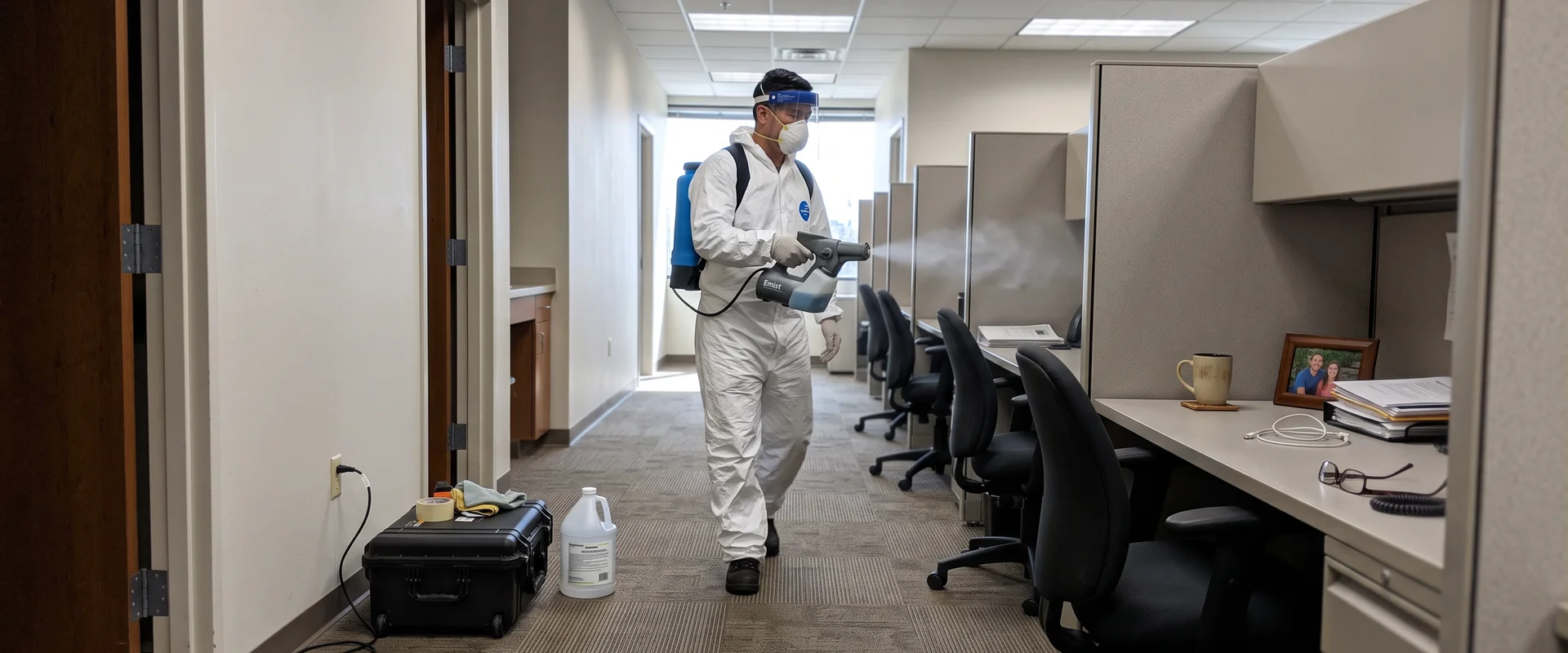
Infection Control & Decontamination in Hamilton
Hospital-grade infection control for COVID-19, C. diff, MRSA, and ESBL, plus a 2-step chemo-patient decontamination using a permanently bonding antimicrobial silicon polymer. This is the rigor behind our government contracts.
- ABRA & IICRC certified
- 1-2 hour emergency response
- Unmarked, discreet vehicles
- Direct insurance billing
Project-based pricing with a free on-site estimate. We bill your insurer directly where the loss is covered.
Are you facing the overwhelming task of clearing a neglected estate for a loved one? It often feels like an impossible mountain to climb.
We understand how deeply stressful and unsafe this process is for families.
The hidden hazards left behind require professional Infection Control & Decontamination to protect your health. As a professional service team, we focus on making the environment truly safe for everyone involved by targeting:
- Lingering pathogens from pests or rodents
- Dangerous bacteria like C. diff
- Unseen viral threats on high-touch surfaces
This guide will walk you through the exact methods used to restore these spaces. You will see exactly how to bring safety and peace of mind back to the property.
What Specialised Infection Control Involves
Infection control is not just wiping surfaces down with a stronger grocery store product. This process is a strict protocol determined by the specific organisms hiding in a heavily cluttered or neglected home. We see this in person when handling severe biohazards like pest waste or mold.
- Enveloped viruses: Viruses such as SARS-CoV-2 are comparatively fragile and fall to most hospital-grade broad-spectrum virucides.
- Resilient bacteria: Bacteria like MRSA and ESBL-producing organisms need appropriate bactericidal chemistry and proper cleaning first, because physical soil load shields them.
- Spore-forming hazards: Clostridioides difficile (C. diff) forms hard spores that survive standard products and requires targeted sporicidal chemistry with extended contact time.
A 2026 University of Cincinnati study found that people with metabolic conditions like type 2 diabetes face an 11 percent higher risk of contracting C. diff. Making these environments safe is absolutely critical for vulnerable family members.
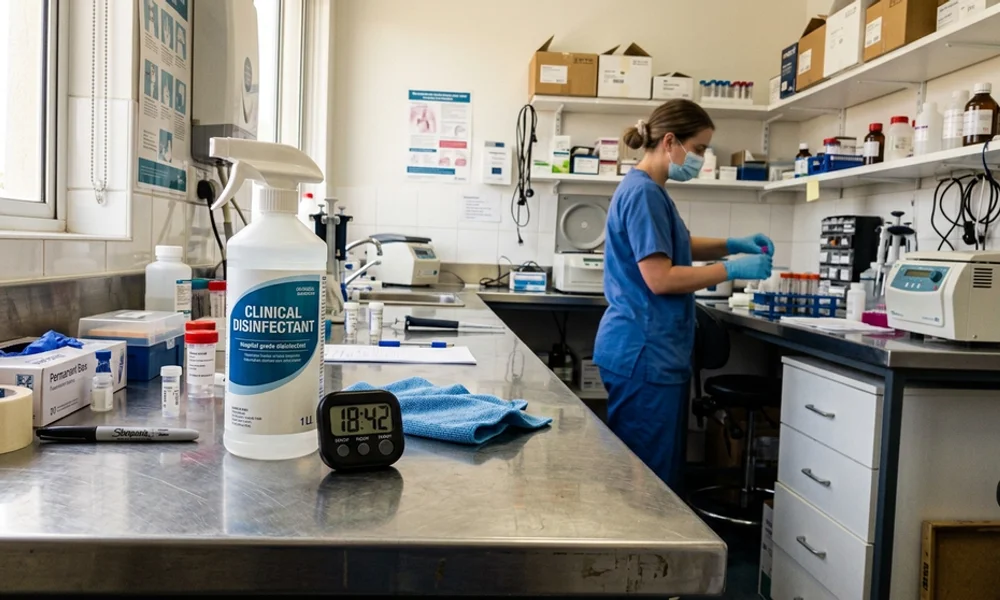
The step that gets skipped most often across the cleanup industry is dwell time. Every disinfectant requires a specific contact time to achieve its label claim. Wiping a counter away early produces a clean-looking surface that is completely unprotected.
We time every single application. This careful timing makes the difference between the work meaning something and failing completely.
Health Canada introduced the Biocides Regulations in May 2025 to standardize surface disinfectants. We strictly use products with a registered 8-digit Drug Identification Number (DIN) from Health Canada. This guarantees the chemical is legally approved to eliminate the specific biohazards in your property.
Our Cleanliness Standard: We verify the safety of the space with ATP bioluminescence testing, ensuring surfaces measure below the strict threshold of 390 Relative Light Units (RLU) per 100 square centimeters.
This testing uses a specialized device called a luminometer to measure residual biological material on a surface. The device returns a precise number in RLU for your files.
Those readings go directly into your final service record. You can confidently show a landlord, an insurer, or an estate lawyer that the property meets rigorous safety standards.
Where We Work
We handle environments ranging from commercial premises and medical offices to long-term care settings and private homes. This broad experience allows us to manage any level of contamination.
Our team holds government contracts for infection control at isolation centres across Canada. The exact protocols developed to satisfy those strict requirements are the same ones applied to your family member’s neglected estate.
Property-managed buildings and two-room dental clinics rely on our detailed approach. You deserve that exact same level of institutional safety when clearing out a hoarding situation.
Common Problems We Solve
An Outbreak in an Occupied Facility
Care facilities and group homes need decontamination fast, and they need documentation immediately afterwards. We prioritize rapid outbreak dispatch to protect vulnerable residents. The technicians on staff work around occupancy where necessary to minimize disruption.
We produce detailed per-visit records that stand up to scrutiny. A clear record is essential when an estate executor or health inspector asks what was done and when.
C. diff Treated With the Wrong Product
Families regularly call us after a general cleaning service failed to stop a pathogen recurrence in a home. A recurring biohazard cycle usually happens for three distinct reasons:
- The standard cleaning product used could not kill hardy spores.
- The required dwell time was ignored entirely by inexperienced cleaners.
- Thorough physical cleaning did not precede the chemical disinfection.
A thick soil load shields the organisms from the spray. We correct all three of these common errors to finally end the dangerous cycle. Using a targeted sporicidal solution like a Health Canada-approved accelerated hydrogen peroxide completely eliminates the hazard.
Preparing a Home for an Immunocompromised Patient
A family member might be coming home during chemotherapy, or right after a major transplant. The entire household understandably wants to reduce every possible environmental risk. We use a specialized two-step protocol to decontaminate the environment completely.
This comprehensive method applies a permanently bonding antimicrobial silicon-based polymer to all high-touch areas. The barrier keeps working on treated surfaces long after the team leaves the property. You get true peace of mind knowing the space is actively resisting new bacteria.
Disinfection Nobody Can Verify
Hearing a cleaner say they sprayed the whole place is simply not a defensible record for an estate. ATP readings, product records, and dated service documentation give a property manager or executor something concrete. We provide this undeniable proof with every single job.
These detailed reports give a family confidence that the space is genuinely safer. A home should be scientifically clean, rather than simply smelling of heavy bleach and artificial fragrances.
Scheduling, Cost, and Records
One-time decontaminations are quoted after a free, transparent assessment of the property. Facilities and property managers usually prefer a scheduled program priced per visit. This ongoing option includes outbreak response built in at a priority dispatch level.
Every single visit produces rigorous documentation for your files. The report details what was treated, with what product, at what exact dwell time, and what the verification readings were. We ensure that this record acts as your ultimate proof of safety.
For clinics, commercial operators, and estate executors, that record is often as valuable as the work itself. Where a household member is immunocompromised, our guide on home decontamination for chemotherapy patients covers the additional precautions. It is exactly what you produce when a health officer or legal representative asks for proof.
| Standard Estate Clearing | Specialized Infection Control |
|---|---|
| Uses retail-grade surface cleaners | Uses Health Canada DIN-registered biocides |
| No scientific cleanliness verification | Uses ATP bioluminescence testing (Target < 390 RLU) |
| Wipes surfaces away immediately | Enforces strict chemical dwell times |
| Leaves potential spore hazards behind | Uses sporicidal chemistry to destroy C. diff |
If you are managing an active outbreak or an overwhelming hoarding situation, call now rather than reading further. We can usually be on site the same day to begin your Infection Control & Decontamination assessment. Prompt action stops the spread of pathogens and accelerates the recovery of the property.
What's Included
- COVID-19, C. diff, MRSA & ESBL disinfection
- 2-step antimicrobial silicon-polymer process
- Chemo and cancer-patient decontamination
- Verified, documented decontamination
- Commercial, medical, and residential sites
- Outbreak response with priority dispatch
How Much Does Infection Control Cost?
Every job is priced on severity, scope, and disposal, so these are planning ranges rather than quotes. The on-site assessment is free, and where the loss is covered we bill your insurer directly.
Single Decontamination
One-time viral or bacterial disinfection
- High-touch surface disinfection
- Hospital-grade broad-spectrum virucides
- Correct dwell time observed throughout
- Completion documentation
Facility Program
Scheduled commercial or medical service
- Everything in the single decontamination scope
- Electrostatic or fogging application
- ATP bioluminescence verification
- Documented service records per visit
- Outbreak-response priority scheduling
Chemo / Immunocompromised
2-step antimicrobial polymer protection
- Everything in the facility program scope
- 2-step decontamination protocol
- Permanently bonding antimicrobial silicon polymer
- Soft-goods and HVAC treatment
- Pre-discharge readiness confirmation
Infection control is quoted on area, pathogen type, surface count, and whether antimicrobial coating is applied. Recurring schedules for clinics, facilities, and commercial sites are priced per visit.
Why Choose Us for Infection Control
What you get with Hamilton Hoarding Pros that a general cleaning or junk-removal crew cannot provide.
Government-Contract Rigour
We hold contracts for infection control at testing and isolation centres. The protocols we run for a small clinic are the ones that had to satisfy those requirements.
Dwell Time Is Not Optional
Most disinfection failures come from wiping a product off before its contact time elapses. We time it. That single discipline separates real disinfection from spraying.
C. diff Capable
C. difficile spores survive standard disinfectants. Treating them requires sporicidal chemistry and extended contact time, and most commercial cleaners do not carry either.
Verified With ATP
Bioluminescence testing gives a numeric reading of residual biological material, so completion is documented rather than asserted.
Antimicrobial Polymer Option
A permanently bonding silicon-based coating continues working on treated surfaces after we leave, which matters for immunocompromised occupants.
IPAC Trained Crews
Infection Prevention and Control training means our technicians understand cross-contamination pathways, not just how to operate a sprayer.
How Our Infection Control Works
No surprises. This is the sequence from your first call through to documented clearance.
- 01
Scope the Pathogen
C. diff spores, MRSA, ESBL, and enveloped viruses each require different products and dwell times. We confirm what we are treating first.
- 02
Prepare & Protect
Sensitive equipment is protected, surfaces are cleaned of soil load, and the crew works in PPE appropriate to the organism.
- 03
Apply Correctly
Application by wipe, electrostatic sprayer, or fogging, with the product's required contact time actually observed rather than rushed.
- 04
Verify & Record
ATP bioluminescence readings confirm the result and become part of the service record you keep on file.
How Hamilton Hoarding Pros Compares
| Feature | Typical Provider | Hamilton Hoarding Pros |
|---|---|---|
| Pathogen scope | General disinfectant only | Sporicidal for C. diff, virucidal, bactericidal |
| Dwell time | Wiped off immediately | Timed to product specification |
| Verification | None | ATP bioluminescence with records |
| Staff training | General cleaning staff | IPAC trained technicians |
| Residual protection | None | Optional bonded antimicrobial polymer |
| Documentation | Invoice only | Per-visit service records |
Infection Control in the Field
Documentary photos from real jobs, shared without identifying details. Click any image to enlarge.
Need infection control handled properly?
One call, a free assessment, and a crew that can legally do the whole job.
What Customers Say About Our Infection Control
Every job is confidential. These are real situations our crews handled across Greater Hamilton and Kitchener-Waterloo.
My father passed alone in his apartment and wasn't found for over a week. Dean's team arrived within an hour, handled everything with incredible sensitivity, and dealt directly with our insurance. I never had to set foot in that apartment again.
I manage 40+ rental units across Kitchener-Waterloo. When a tenant left behind a severe hoarding situation with animal waste and needles, Hamilton Hoarding Pros had the unit safe and rent-ready in three days. No other company I called would even take the job.
Our basement flooded with sewage at 2 AM on a Sunday. They answered immediately, arrived by 3:30, and worked through the night. The tobacco smell that had lingered for years was gone after their ozone treatment too. Genuinely saved us from a far worse outcome.
Infection Control FAQs
Is regular cleaning enough for C. difficile?
What does dwell time actually mean?
Do you service commercial and medical facilities?
What is the 2-step chemo patient decontamination?
Why do chemo patients need home decontamination?
How do you verify the disinfection worked?
Can you respond to an outbreak quickly?
Is the treatment safe for occupants and pets?
Do you treat soft furnishings and HVAC systems?
How much does infection control cost?
Infection Control Guides
Plain-language answers to the questions people ask before they call us.
Viral & Bacterial Disinfection: C. diff, MRSA & COVID-19
Pathogen profiles, hospital-grade virucides, dwell times, and verification, and when standard cleaning is not enough.
Chemo & Cancer-Patient Home Decontamination: What's Involved
The 2-step process and permanently bonding antimicrobial silicon polymer that protect immunocompromised patients, and what the service covers.
Related Services
Ready to Book Infection Control?
Certified infection control & decontamination with a free on-site assessment, complete discretion, and direct insurance billing.