The Direct Answer
We know exactly how overwhelming it is to clear an estate or handle a trauma scene for a loved one. You likely want to jump in and get it done, but tackling biohazards yourself is highly risky. Yes, it is dangerous, and the danger is not what most people picture.
Our experience shows the threat is rarely dramatic. It is a needle you did not see, a splash you did not notice, or a surface that looked clean and was not.
The situation presents three separate risks running at once: pathogen exposure, inadequate decontamination that leaves the space unsafe, and disposal that has no lawful route. We consider each one on its own a reason to be extremely careful. Together, they are why certified trauma cleaning exists as a dedicated discipline. Proper remediation requires specific training and equipment.
What Blood and Bodily Fluids Actually Carry
We classify these hazards under bloodborne pathogens, with hepatitis B, hepatitis C, and HIV being the primary concerns. Beyond those sit what safety standards call Other Potentially Infectious Materials, which includes most bodily fluids.
Two facts from the Public Health Agency of Canada completely change how people view this risk. Our teams operate under the knowledge that hepatitis B can remain infectious on a dried surface for up to seven days. A scene does not become safe simply because a spill is no longer fresh. The virus requires very little to infect a new host.
We also have to worry about the actual routes of exposure. The biggest threats are not contact with intact skin. Instead, the danger lies in a microscopic cut you already had, an accidental splash to the eye, or a puncture from something concealed in soft material.
The Hidden Risks of Decomposition
We see decomposition add a severe, secondary layer of danger to these sites. Bacterial load rises significantly within just a few hours.
The airborne compounds produced during this process are deeply unpleasant. Our respiratory protection is necessary because these gases become genuinely irritating to the human respiratory tract in confined spaces. Families often overlook the less obvious hazards hidden in the room.
Here is a list of common unseen threats:
- Dried blood flakes turning into airborne dust.
- Hidden sharps like diabetic needles inside mattresses.
- Fluid seepage reaching the subfloor.
- Infectious fluids trapped behind baseboards.
Why Household Cleaning Does Not Work
Porous Materials and Dwell Time
We always warn clients that carpet, underlay, mattresses, upholstery, drywall, and subfloor act like giant sponges for fluid. Once absorbed, no amount of surface treatment reaches the core contamination. The material has to be removed completely, which is why professional scopes look more aggressive than people expect.
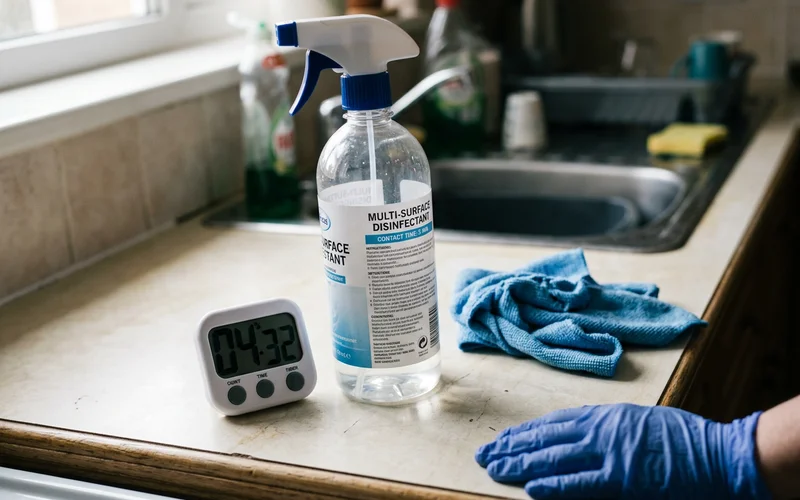
Our technicians understand that every disinfectant requires a specific contact time to achieve its kill claim. Hospital-grade quaternary ammonium compounds often need a full 10 minutes of wet dwell time to destroy bloodborne pathogens. Almost everyone wipes standard household cleaner away within seconds.
We know a surface cleaned this way is clean-looking, but it is definitely not disinfected. Chemical effectiveness relies entirely on proper application. Rushing this step leaves active pathogens behind.
Cross-Contamination and Verification
We see the mistake of cross-contamination on almost every DIY attempt. Wiping simply moves biological material across a surface. Mopping distributes the hazard even further around the room.
Our containment protocols prevent this material from traveling into completely unaffected areas. A major issue is that you cannot visually confirm the result of a cleaning attempt. To solve this, professionals rely on ATP bioluminescence testing to measure residual biological material at a microscopic level.
We look for a passing score of under 100 Relative Light Units to confirm a safe surface. A pre-cleaned trauma surface can easily read well over 50,000 RLU. Without this testing technology, visual assessment of decontamination is completely unreliable.
| Factor | Household Cleaning | Professional Remediation |
|---|---|---|
| Dwell Time | Seconds (Wiped away immediately) | 10+ Minutes (Full saturation) |
| Chemicals | Standard surface cleaners | Accelerated hydrogen peroxide, Quats |
| Verification | Visual inspection | ATP Testing (<100 RLU) |
The Disposal Problem
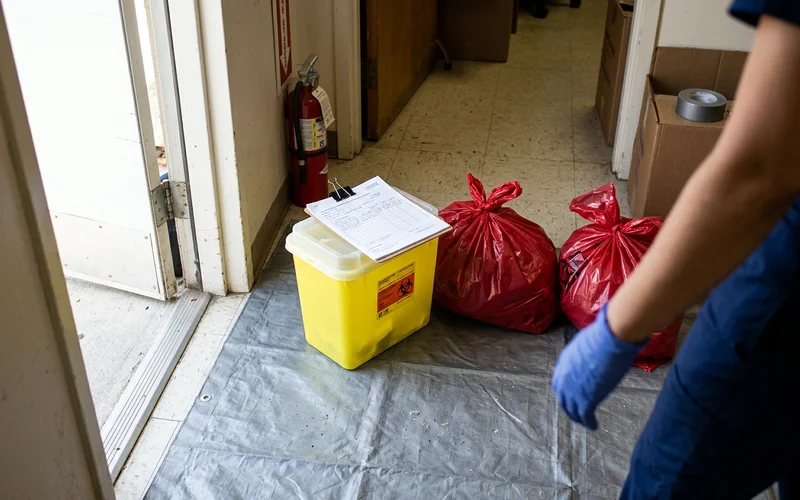
We consistently see families hit a massive practical wall when the physical cleaning is done. Material contaminated with blood or bodily fluids automatically classifies as biohazardous waste. In Ontario, this falls under the strict guidelines of the Environmental Protection Act and Regulation 347.
Our disposal process strictly follows this regulation, ensuring biomedical waste is segregated, packaged in specifically rated containers, and transported by licensed haulers. A homeowner has absolutely no access to that legal route. Municipal transfer stations actively refuse these loads at the gate.
We must remind clients that putting biohazards in regular household waste is unlawful. Illegal dumping of hazardous waste carries fines that can reach up to $50,000 for individuals in Ontario. It also exposes local sanitation workers to a severe hazard they have no reason to expect.
What professional PPE actually is
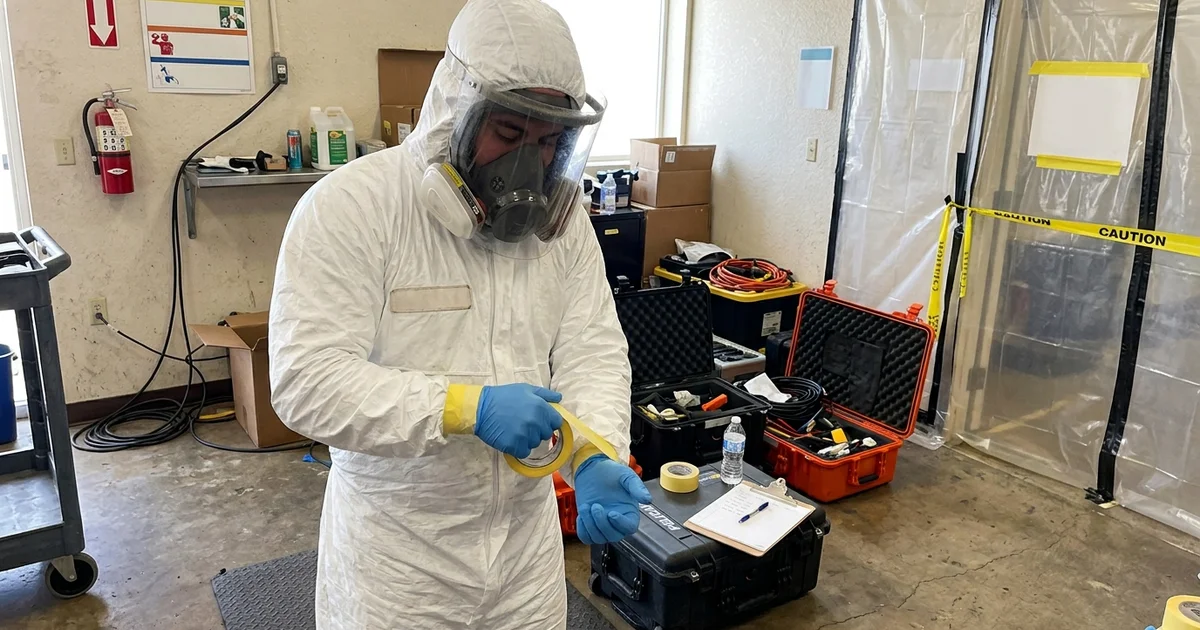
Tyvek or equivalent barrier suits, P100 respirators or full-face protection, double nitrile gloves, boot covers, and eye protection. Plus containment: barriers and negative air pressure so nothing migrates into clean areas. This is not overcaution. It is the minimum standard for working in an environment with unknown pathogen load.
What Professional Remediation Does Differently
We start with rigid containment before anything is disturbed, ensuring contamination cannot travel through the air. Technicians use negative air pressure setups with HEPA filtration to capture microscopic airborne particles. Next, the focus shifts to the physical removal of porous materials that have absorbed fluid, rather than attempting a futile cleaning process.
Our teams apply hospital-grade disinfection, utilizing accelerated hydrogen peroxide or specialized quaternary compounds on non-porous surfaces. These chemicals must sit for their full required dwell time to be effective. Sharps recovery is performed using puncture-resistant equipment, placing needles directly into CSA-approved containers.
How Decontamination is Verified
We prove the site is safe through rigorous, scientific verification. ATP readings measure the residual biological material directly and produce a definitive number. Those passing readings go directly into the documentation you keep.
Our guide on how decontamination is verified explains this method in great detail. This testing guarantees a completely safe environment for the next occupants. The final step is handling lawful disposal under Guideline C-4 protocols, providing you with the government manifest.
We ensure a complete remediation process provides peace of mind. This approach delivers several specific guarantees for your property:
- Total isolation of the affected zone.
- Scientific verification of a safe environment.
- Protection from severe regulatory fines.
Certified cleanup removes the burden from grieving families.
If You Have Already Started
We completely understand why people try to clean things up themselves, usually in that first hour before anyone has fully thought it through. Stop right now, carefully remove and bag what you were wearing, and wash your hands and body thoroughly.
If you sustained any cut or puncture during the process, you must seek medical advice immediately. We urge anyone exposed to ask a doctor about Post-Exposure Prophylaxis protocols for HIV and hepatitis.
Canadian health guidelines state this 28-day pill regimen must begin within 72 hours of the exposure, but ideally, you should start it within hours. Getting help quickly drastically reduces the chance of long-term health consequences.
We encourage you to call a professional team right away to take over the site.
A partial cleanup attempt does not make the final remediation harder. Nobody is going to make you feel foolish for trying to help your family through a crisis.