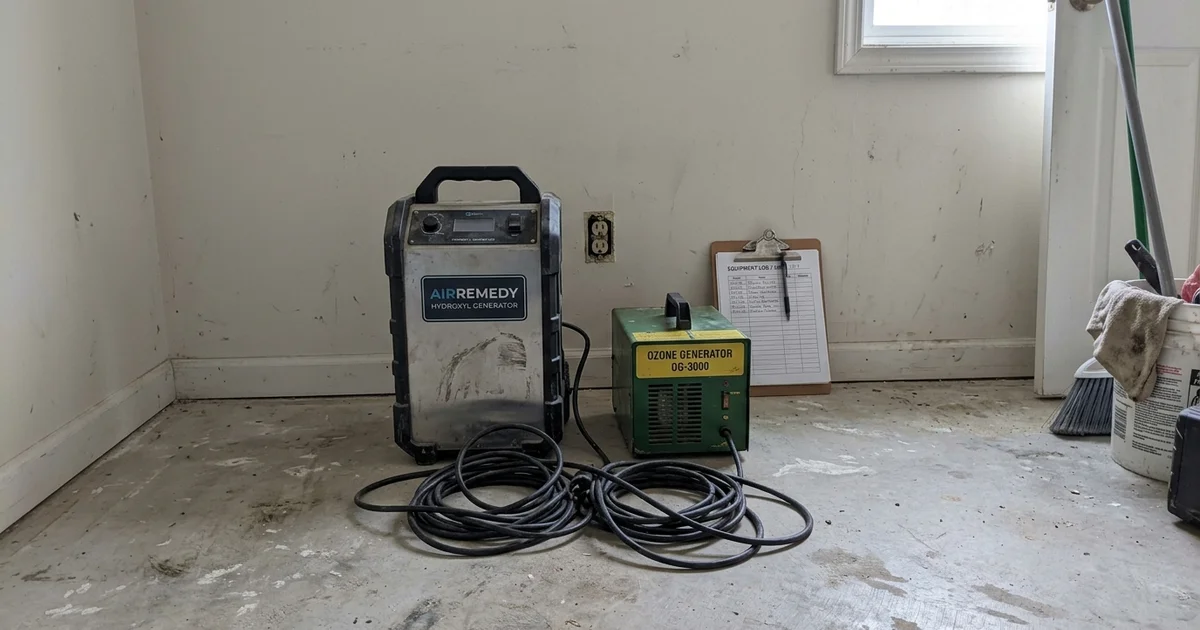
They Are Not Interchangeable
You know how overwhelming an estate clearance can become when severe, embedded odours are present.
Our teams frequently step into these exact situations. Recent 2026 data shows that an estimated two to six per cent of the Canadian population deals with clinically significant hoarding, turning standard three-week cleanouts into complex remediation projects.
We must establish a clear baseline right away. Choosing an ozone vs hydroxyl odour treatment is mostly a question of occupancy and penetration depth, but neither technology can remove a physical source. Our strict rule for every odour removal job is to perform source removal first.
If a urine-saturated underlay remains in the home, any treatment only addresses the air while the source generates new compounds. We will break down the exact data behind these methods and outline a clear plan for your property.
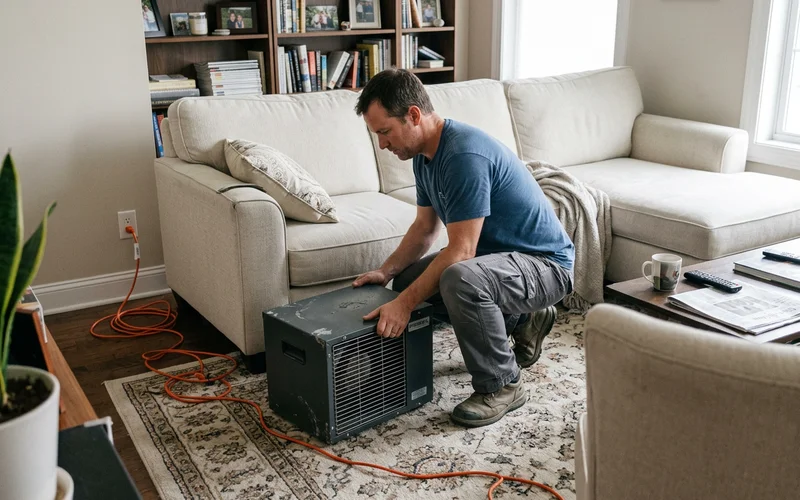
Ozone (O3)
Fast results make this a common choice for empty properties. Our technicians deploy ozone generators to produce O3, a highly reactive molecule that oxidises odour compounds on contact. This process breaks the compounds into simpler, odourless substances.
We always strictly enforce safety protocols because ozone is a severe respiratory irritant. Health Canada guidelines for residential indoor air quality set a maximum exposure limit of just 40 micrograms per cubic metre for ozone, and the space must be completely empty of pets and plants. Our equipment generates concentrations far above that safety threshold to be effective.
A strictly defined airing-out period is mandatory before anyone can re-enter the treated area. We ask clients to consider the following main factors before choosing ozone:
- Strengths: It is the most aggressive option available, penetrating well into soft goods to handle severe contamination.
- Limitations: Prolonged exposure degrades rubber and certain plastics, and the mandatory vacancy requirement complicates logistics.
- Use it for: Vacant properties, severe tobacco odour, fire damage, and lingering decomposition odours after source removal.
Hydroxyl Radicals
Safe operation around people makes this technology incredibly versatile. Our hydroxyl generators use specific UV light to produce hydroxyl radicals from ambient indoor humidity. These radicals break down odour molecules through the exact same oxidative chemistry that occurs naturally in the atmosphere.
We frequently encounter a myth that these units require 60 per cent humidity to function. Advanced units from 2026 actually operate effectively with ambient humidity levels as low as 5 per cent. Our teams never need to add artificial moisture to a home to make the equipment work.
This method is slower and less aggressive than ozone, requiring longer run times for severe contamination. We recommend this approach when evacuation is simply impossible. It is ideal for the following scenarios:
- Occupied homes where families are currently sorting through an estate.
- Apartment buildings with shared ventilation systems.
- Commercial premises that must stay open during treatment.
- Moderate odours remaining after the main source is removed.
| Method | Occupied space | Speed | Penetration | Best for |
|---|---|---|---|---|
| Ozone | No | Fast | High | Severe odour, vacant properties |
| Hydroxyl | Yes | Slower | Moderate | Occupied homes, ongoing operations |
| Chlorine dioxide | No | Moderate | Very high | Deep structural penetration |
| Thermal / ULV fogging | Varies | Single application | Reaches cavities and soft goods | Soft furnishings, inaccessible voids |
Chlorine Dioxide (ClO2)
Deep structural odours sometimes survive standard treatments. Our specialists use chlorine dioxide gas when an odour has bonded into a building structure and ozone has not fully resolved it. At just 0.124 nanometres in size, the ClO2 molecule is a true gas.
We rely on this tiny molecule size because it easily penetrates drywall, carpet padding, and subfloors that block larger aerosol droplets. This treatment demands complete vacancy, strict containment, and highly controlled application.
Our technicians treat this as a specialist option rather than a first choice. It perfectly suits the worst decomposition cases, severe smoke damage, and hoarding situations where biological contaminants have soaked into porous materials.
Thermal and ULV Fogging
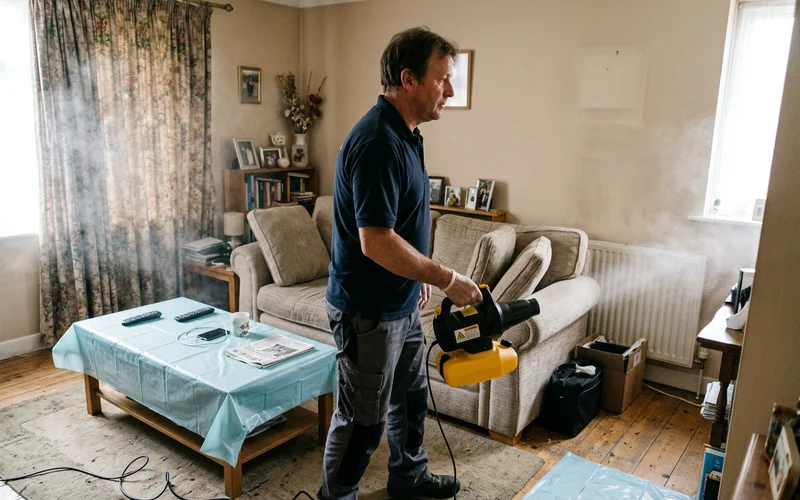
Spraying an agent directly into the air helps tackle soft furnishings and wall cavities. Our preferred thermal fogging odour protocols distribute a fine mist to reach voids that gas treatments only penetrate slowly. Thermal foggers use heat to produce ultra-fine particles ranging from 0.5 to 10 microns in size.
We use thermal fogging after a fire because these tiny particles perfectly mimic the penetration pattern of actual smoke. Cold fogging, or ULV fogging, produces slightly larger droplets measuring between 10 and 30 microns. Our teams consider ULV fogging the best odour removal method for coating indoor surfaces evenly without the fire risks associated with heat-based equipment.
Fogging deposits an active agent on surfaces rather than continuously oxidising the air. We generally use it alongside another primary method to guarantee a complete clean.
Vaportek dry vapour systems
A gentler, continuous approach using natural essential-oil-based vapour, suitable for occupied spaces and for maintaining a result between stages. Useful as a supporting measure rather than a primary treatment for severe odour.
How We Actually Choose
Every property presents a unique set of challenges. Our approach changes based on the timeline, the type of contamination, and whether the family needs to remain on-site. A single, universal solution simply does not exist for complex estate clearances.
We have developed specific combinations of treatments to handle the most common scenarios effectively. Here is exactly how those combinations break down in the field:
- Vacant property with severe odour: Ozone is deployed after source removal, followed by a strict airing-out period.
- Occupied property: Hydroxyl generators run for extended periods, combined with ULV fogging for soft goods if required.
- Deeply penetrated structural odour: Complete source removal and physical sealing happen first, followed by chlorine dioxide gas or extended ozone treatment.
- Fire and smoke damage: Thermal fogging pairs perfectly with ozone, because the smoke penetration patterns suit that specific combination.
- Post-remediation finishing: Hydroxyl units or Vaportek systems run continuously to finalize the result.
We document all of our procedures to ensure consistent, high-quality results. A single method offered for every situation is just equipment availability talking rather than a professional assessment.
Our teams always emphasize that choosing an ozone vs hydroxyl odour treatment requires careful planning and a clear strategy. For a detailed, worked example of how this applies to a common situation, read our comprehensive guide on tobacco odour removal.